Tools for Changing Behavior: Part 2 of 3
TW: compulsive exercise
Controlling relationships with our bodies, food, or movement often includes some rules to help us stay on track. When we try to shift our relationship with these aspects of our lives, it often requires adjusting or even letting go of these rules all together. Depending on how long a person has been in this controlling dynamic, the rules will have become second-nature; a habit or even a compulsion.
One such habit that I continue to grapple with is showering after a workout. Or should I say, showering even if I didn’t workout. One of my rules when I would compulsively exercise was to not let myself shower unless I had first sweat from a workout. To this day, taking a shower without first exercising is a process.
Deciding to end this habit first required that I:
confronted my relationship with movement,
identified the ways that relationship was reinforced, and
went through the process of negotiating which rules could stay and which rules needed to go.
Cue, Do I Stay Or Do I Go by The Clash.
The steps above are part of the “Contemplative Stage of Change” from Motivational Interviewing that was identified in Part 1 of this 3 part series around behavior change. In this post we will discuss a tool from Cognitive Behavior Theory, which can help us decide whether or not to make a change at all. Part 3 will review Parts Mapping from Internal Family Systems, which can be helpful during any of the 5 Stages of Behavior Change.
The Decision Matrix from Cognitive Behavior Therapy (CBT)
Or what I like to call, a fancy pros and cons list.
First, identify the behavior in question. Using the example above it would be “Showering without requiring exercise.” You are welcome to consider a different habit you’ve been grappling with.
Second, make a table with 2 columns and 2 rows. One column is for the behavior with change, one is for the behavior without change. One row is for the potential benefits and the other is for the potential costs of keeping the behavior the same and changing it. One of the beauties about the “potential” is that you don’t have to be sure that the cost or benefit will or will not happen. The “potential” allows you to notice fears and hopes, in addition to guaranteed outcomes.
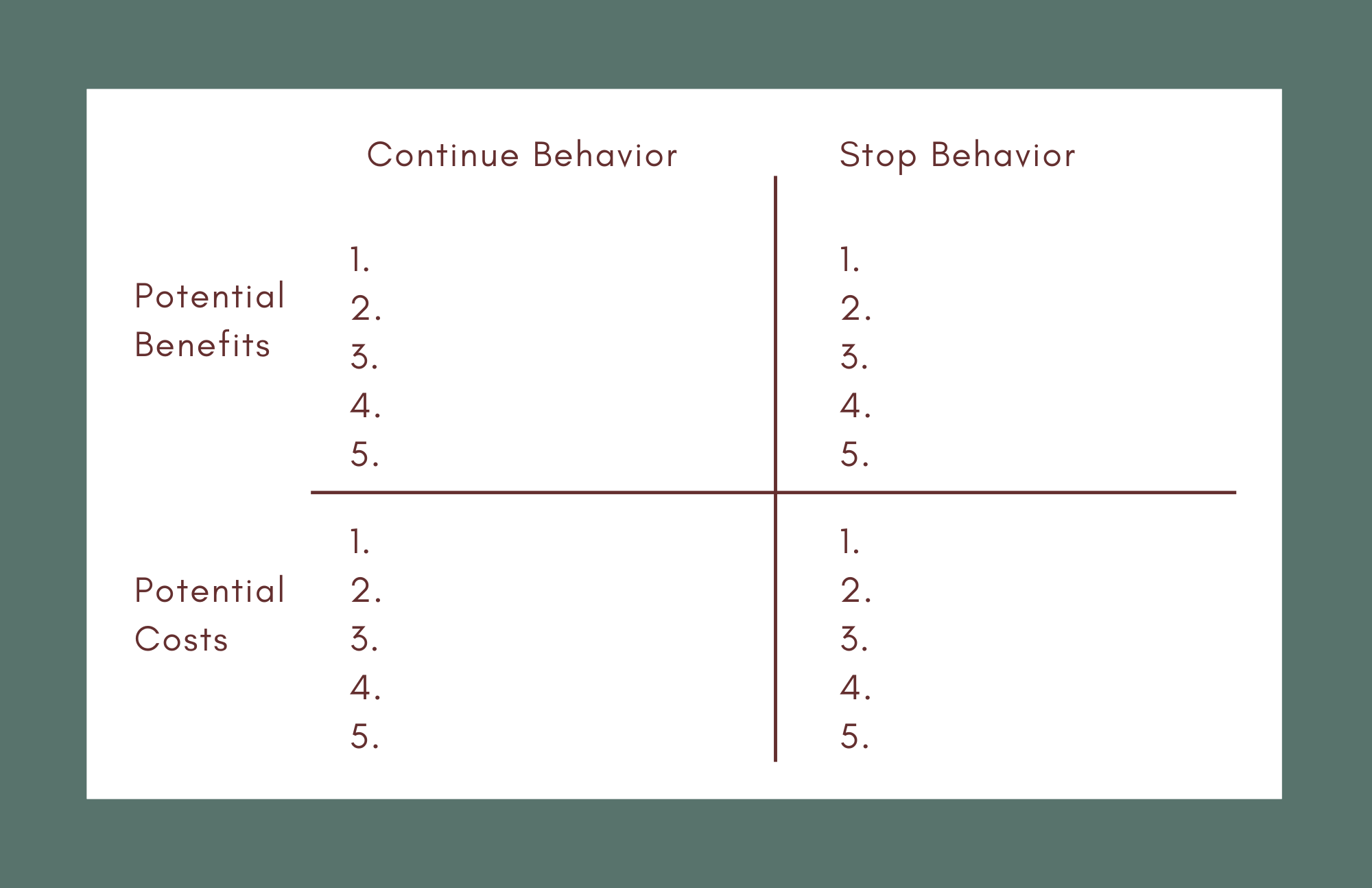
Decision Matrix composed of 2 columns and 2 rows.
Third, fill in the blanks. Start in any area of the matrix that you’d like. I recommend people start with the one that feels the loudest. For example, if you’re having a hard time stopping a particular behavior, maybe you’re more aware of the potential costs of continuing the behavior. Why do you want to stop doing it so much? As you write down reasons, the part of you invested in continuing the behavior might speak up and share potential benefits of continuing as it is. Feel free to jump around and complete the matrix as it feels natural for you. It may be helpful to consider 1 or 2 years down the line, what might happen if this behavior does and does not change?
For the example we’re working with, this is what my Decision Matrix could look like:
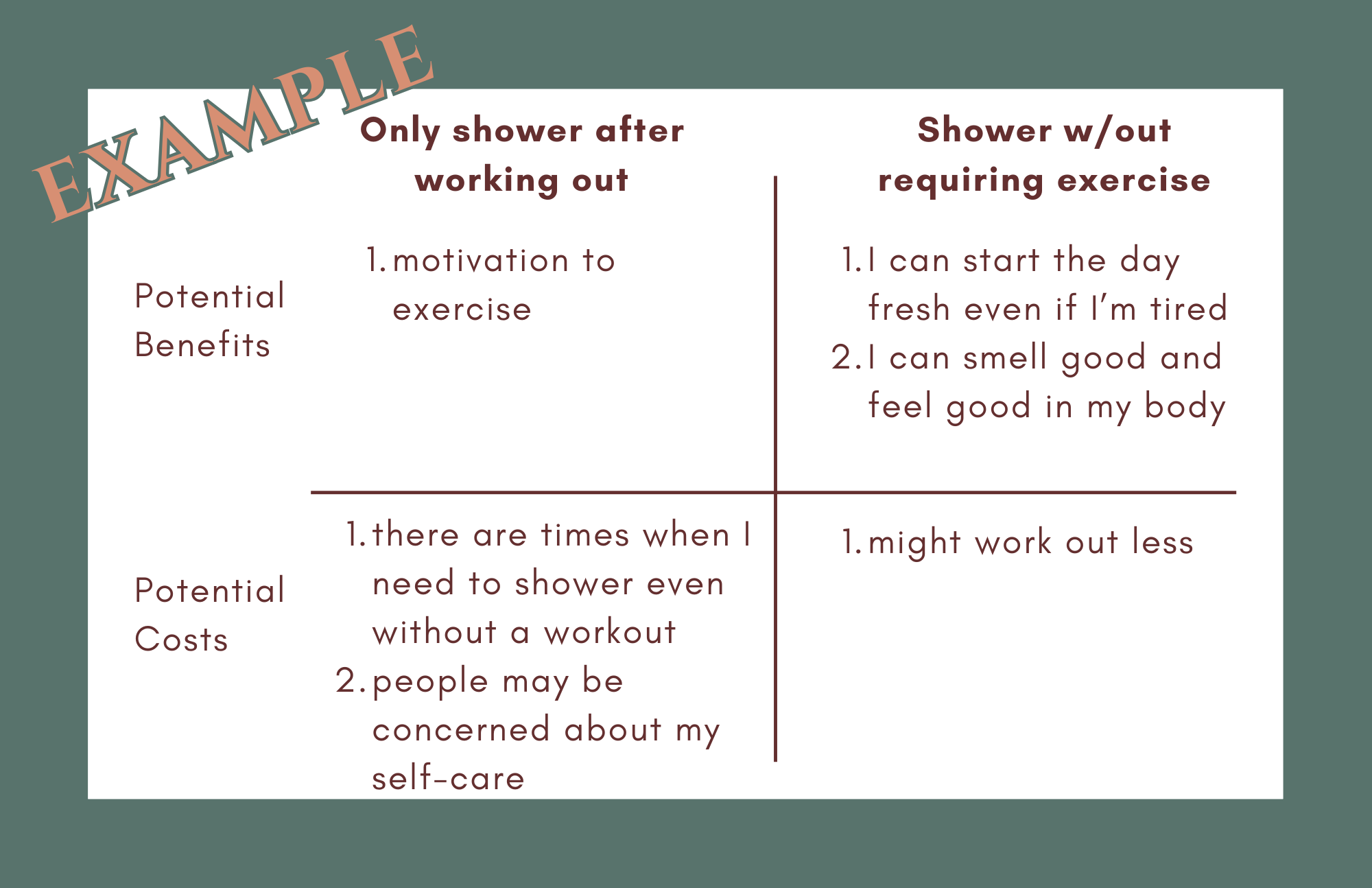
Fourth, reflect on the matrix. Which boxes have more potential costs and benefits? Are there potential costs or benefits that have a greater impact than another? What comes up for you when you look at it all out in front of you? Are there any steps you can take or resources you can use to mitigate potential costs? Is there a change of the behavior that feels more reachable than stopping it all together?
This tool doesn’t not make the decision for you; rather, it brings more clarity about the factors involved. Since the options are “don’t do the thing” or “do the thing,” there’s an opportunity to notice what comes up for you when you consider the potential costs and benefits of the extreme possibilities. There’s a lot of middle-ground between those two binaries and you can decide what is possible for you. Perhaps stopping the behavior 100% isn’t realistic but making an adjustment is, especially considering all the potential benefits of doing so.
The “Potential Benefits” and “Potential Costs” can also provide motivation for moving toward that 100% place as you take baby-steps to getting there. Perhaps you won’t see those potential benefits until you’re 75% there but knowing they’re on the horizon, make help you stay committed.
Reflection Questions
Consider a behavior someone has asked you to change or you’ve been advised to change but you’re not 100% sold about it.
On a scale from 1-5, how clear do you feel about your decision to either continue or to change your behavior? 1 being not clear, 5 being very clear.
Make a Decision Matrix about the behavior where one column is it stays the same and the other column is you stop doing it.
Are there any surprises?
Which quadrant was easier to complete? Do you feel there’s room to learn more information about potential costs or benefits of changing or staying the same?
What would you rate your clarity about your decision to keep or change your behavior now? Is there a step toward change or information about continuing that would help bring more clarity?
These exercises can bring up a lot of feeling of shame, frustration, and stickiness. They can also bring up motivation, activation, and motion. If you’d like support in a behavior change you’re consider, I’d love to hear from you.